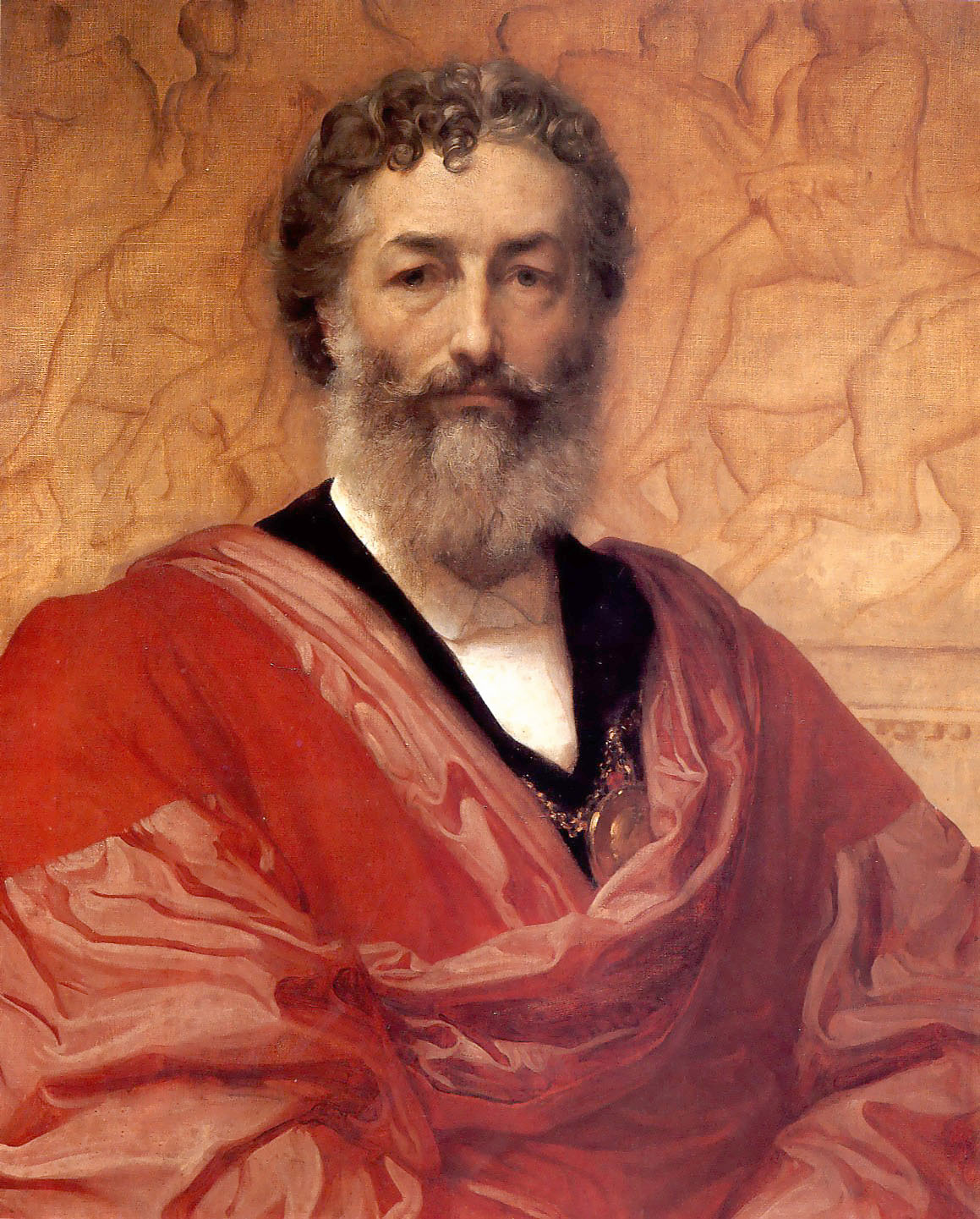
Frederic Leighton
1830-1896
Frederic Leighton trained almost entirely on the Continent—with the Nazarene painter Edward von Steinle in Frankfurt and then Giovanni Costa in Rome, where he painted Cimabue's Celebrated Madonna in Procession. His years in Paris from 1855 to 1859 brought him into contact with Ingres, Delacroix, and Corot, tempering his austere early style with painterly richness and naturalism. Settling in London in 1859, he initially faced resistance from the art establishment, but found champions among the Pre-Raphaelites. His election as Royal Academy associate in 1864 marked his breakthrough; the classical grace of Orpheus and Eurydice and the Venetian splendor of Golden Hours announced his mature vision. From the late 1860s onward, Greek classicism dominated his work, culminating in masterpieces like Hercules Wrestling with Death and the bronze Athlete Wrestling with a Python. He also undertook monumental decorative schemes, including the Arts of Industry murals at South Kensington Museum. Elected Royal Academy president in 1878, Leighton remained extraordinarily productive until his death. His late works—Captive Andromache and the celebrated Flaming June—epitomize the aesthetic movement's sensuous beauty. Weeks before dying, he became the first British artist to receive a barony.