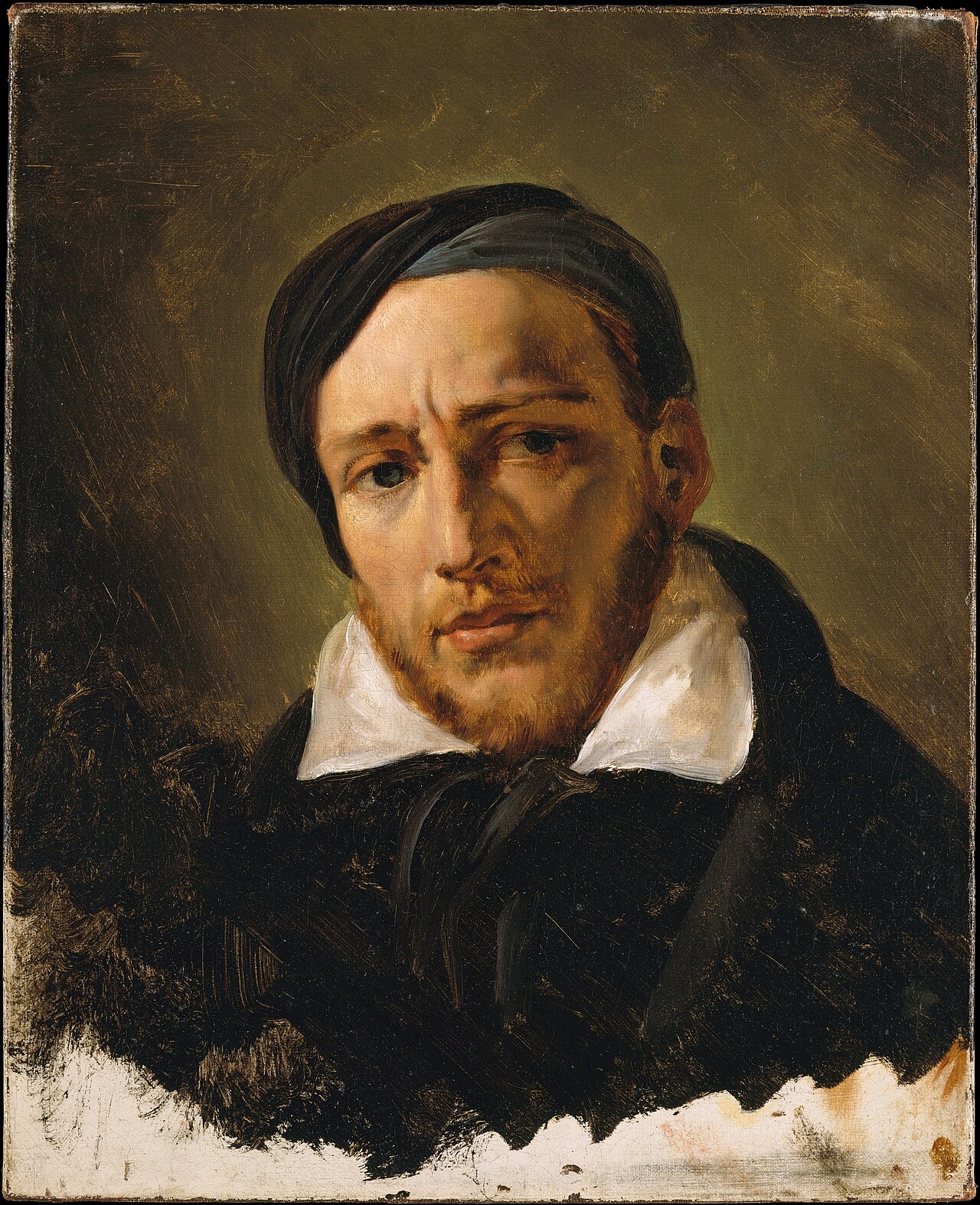
Théodore Géricault
1791-1824
Théodore Géricault painted the extremes of human experience with unflinching realism. Born in Rouen in 1791, he moved to Paris as a child and trained under Carle Vernet and Pierre-Narcisse Guérin, though he ultimately taught himself by copying Rubens, Titian, and Michelangelo at the Louvre. His Charging Chasseur won a gold medal at the 1812 Salon, capturing horses with a vitality his teachers lacked. But Géricault's masterpiece came from tragedy: The Raft of the Medusa (1818–19) transformed a recent shipwreck into monumental drama, depicting survivors in their moment of desperate hope and despair. The painting sparked political uproar when exhibited in Paris, then found acclaim in England. Back in France, he painted a series of psychiatric patients with psychological penetration, and sketched the urban poor. Spinal tuberculosis, worsened by riding accidents, killed him in Paris in 1824, aged 32. He left only three Salon submissions, yet pioneered Romanticism and influenced generations to come.